Ionized Point Defense Cannonning and Mathemating
Hello there everybody!
As one of the 2 biggest area of focus for Armada Community Edition, and probably the most controversial upgrade in the game’s recent history, Point-Defense Ion Cannons was the one card we were most anxious about getting right, or at the very least, as right as possible to give us a more solid pathway to further adjustments moving forward. This article aims to summarize our starting assumptions, the various aspects of the card that were identified as problematic, and how and why the Community Edition rewrite is looking to improve on them.
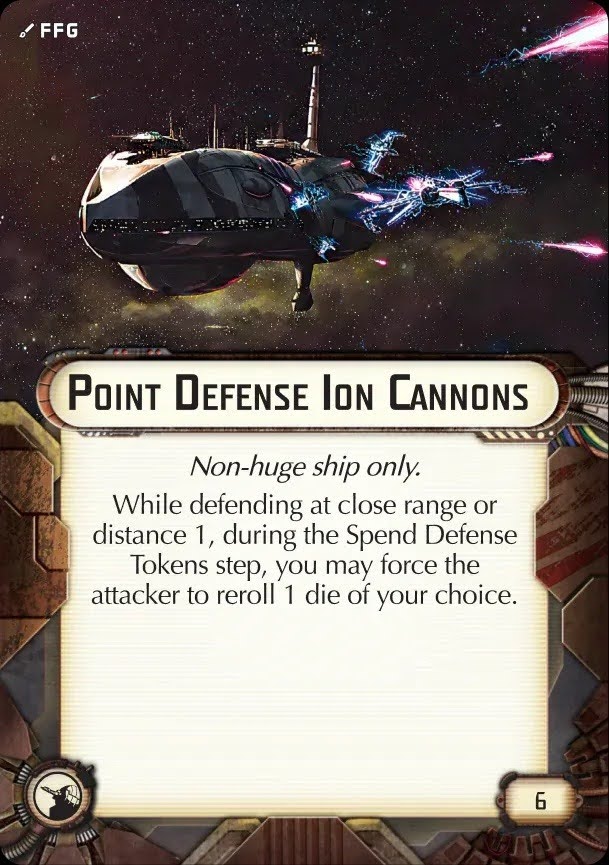
PDIC (old)
Why was PDIC problematic
There is a list of properties that doesn’t seem big each on their own, but together make PDIC the headache that it is today:
It is the only Ion cannon card that is both defensively focused and requires no setup to extract value from. These 2 qualities makes it an incredibly easy choice for any ship with an ion cannon slot that is important enough to be protected, and doesn’t want to otherwise invest in a more specific upgrade. This also lets PDIC be stacked with various other defense upgrades (officers, defensive retrofits, titles) and as a result, lets it contribute to a net of small defense effects that together become massively impactful and make a ship incredibly hard to take down.
Its effect doesn’t require setup, and is unlimited in trigger opportunity. Its only requirement is that the ship be at close range, which is a given for squad attacks and black dice range where a reroll is most likely to be useful. It can then trigger as many rerolls as there are attacks on the incoming ships. The only way to counteract this as the opposing player is either to never attack at close range or to have a way to discard the card altogether.
Practically and thematically speaking, the card is aimed to provide defense against bombing runs and ordnance attacks (especially crit-fueled ordnance attacks). It wouldn’t be a big problem but for the previous 2 points: as a result of PDIC being an easy choice for the ion slot, it is very easy to buy, and as a result of its effect being unlimited in potential, it has little counterplay outside of listbuilding. Squadron builds relying on red dice (that are some of the most affected by reroll) are a liability into PDIC ships. Similar story for fleets that aim to deliver Assault Proton Torpedoes at close range.
Effectively, PDIC as it was implemented on release had all the ingredients required to be massively adopted and as a result to push away certain squadron builds and ship playstyles that were already not the easiest to leverage. It was also primed to encourage making ships extremely hard to kill, and thus often not worth engaging in the first place. As two of our design goals are to promote diversity of viable playstyle and content, as well as player interaction in the games proper, tackling PDIC has been on our to-do list for some time.
What did the release version of PDIC actually do?
Any reasonable attempt at changing PDIC had to be grounded in a solid understanding of what current PDIC does. As it’s essentially just a reroll that you can do a lot of times, it means 2 things:
Not all attacks are affected the same. The value of the reroll depends on the attacker. If you were running all red bomber squads, you were potentially a lot more impacted by seeing this card across the table than if you were running all double-blue bombers. If your ship has black dice at close range, and if you have upgrades that help fix your dice rolls, you also have more chances to provide PDIC the opportunity for turning a double into a single hit or a blank.
Perception of impact is unreliable. It’s another aspect that fueled a lot of online debate on this card. PDIC players could get lucky and mitigate a massive amount of damage in a single round of bombing. Or they could get unlucky, and mitigate nothing. But similarly speaking, the PDIC player opponent could get lucky and generate a lot of opportunities for PDIC to extract value. Or not. This extreme variation in player experience made it difficult to discuss what changes PDIC needed (if any) as different players remembered different experiences with the card, even if the experiences averaged out in the aggregate.
This called for an actual math-driven assessment of the card impact. PDIC effect on ship attacks is fairly straightforward, but squadron builds and their interaction with the ship game live in a finely tuned balance of their own. They’re also where PDIC perception is the most skewed, as any given squadron list is going to generate a lot of rerolls.
While it is easy to see how the card would affect red dice squads more than black dice squads, we needed to know exactly by how much, in order to set a baseline.
So what we did during this development cycle was also to produce a study of the expected impact of the release version PDIC upgrade on various squadron builds, mostly based on the most common squadballs players use in competitive play, and including common abilities affecting those squads output.
Link to the PDIC Study
(more information on the study, methodology and results included inside)
The main thing to take away from this is that on average, on dedicated squad builds, while it does vary depending on the actual squadball, PDIC is expected to negate a bit more than 2 damage worth if every squad gets a shot at the ship. In practice, having every squad go at a PDIC ship doesn’t always happen, and of course the reroll variance factors in the equation, but the average gives us a good idea of where the line is on current impact.
How did we change PDIC and why did we do it this way
There were a lot of possibilities for adjusting the card. Everybody has their own ideas about how to tackle this card. It generated countless discussions, in our development team and beyond, with opinions ranging from not touching it, to making it a mod (possibly alongside other defensive upgrades), to altering text, to making the rerolls tied to some resource, to soft-banning it with a points hike…
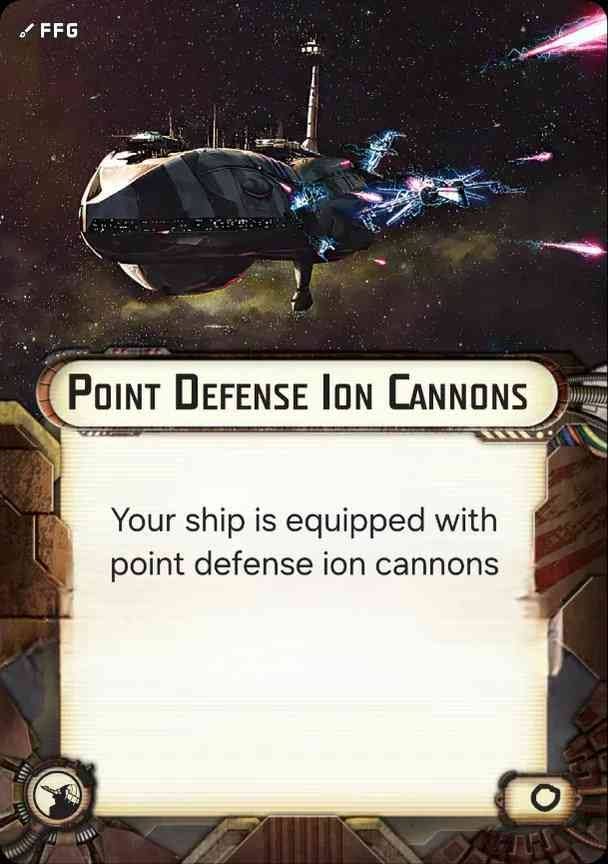
The most infamous suggestion...
So we looked at it methodically and from the angle of what we wanted to achieve with a change. The idea that PDIC was too strong into crit builds and close range brawling ships was the first basic assumption we were running with, and as far as we could gather, it is a widely shared opinion in the community. Our second basic assumption was that as a generic squadron defense tech, the card shouldn’t have a different potential impact on different squadron armaments. And especially, it should not hit harder on the squadrons that are the least reliable (and thus least favored) to begin with.
These 2 concerns together excluded fixing the card purely by points change, in our view.
In short, we wanted to keep the card as slightly useful against ships, but dramatically less effective against brawling and crit builds than it currently is, and also keep its niche of being of use against squadron attacks.
Finally, tackling the unlimited aspect of the card was very important to us in order to make the card more interactive. This would mean giving opposing players opportunities to overcome PDIC through their gameplay, rather than only through their listbuilding.
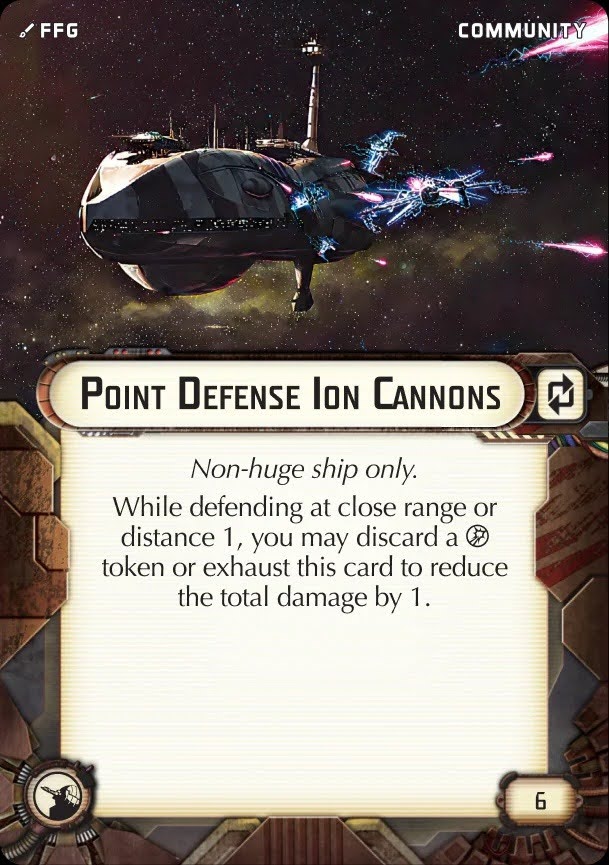
PDIC (new)
Removing the reroll in favor of a flat reduction is meant to remove the perception effect and normalize the card potential. The attack damage can be reduced by 1 now regardless of the attacker’s result or die color, which over multiple attacks is a net gain for red dice squads for instance. At the same time, this change of effect also means PDIC does not affect whether or not an attack is crit-enabled anymore.
The effect itself is stronger (a guaranteed -1 damage vs a reroll that may do nothing, or sometimes even be worse, if the PDIC player feels like gambling or is desperate), however, it is also now capped in potential rather than unlimited. Extracting more than 1 damage mitigated per round will require token support, which is less easy than it sounds over the course of a game. Mitigating more than 2 damage in a single round will now require some serious token shuffling and timing over multiple activations. Attackers can also now overcome PDIC through volume of attacks, unlike before where such a strategy would also require you to have luck on your side.
Early in development, we also provided the card with a third way to use the card through a blue-crit ability, but testing showed this was extremely situational and overall unneeded, so in the end, we decided to cut it for the sake of clarity.
As for the combination of a damage-reduction PDIC with other defensive upgrades like EST, EWS and others on very heavy ships, we’re confident than this version of the card is going to provide less of a benefit to those builds than reroll-PDIC was, considering that the reroll would reduce more damage on average against a bomber wing. Additionally, building fleets with critical effects in mind is now a path to cracking those fortress ships that a reroll was actively negating (unless running Admiral Screed). And with a much less variable effect, it will be easier for us to accurately adjust the cost of the upgrade based on its performance in play.
If you’re still with us reading these final lines, and even if you think PDIC didn’t need a change, or that specific change, we hope the rationale behind why we updated this card the way we did is more clear to you now ! And hopefully in the coming months, we’ll see various interesting ways fleets adapt, with or against the new point defense cannons. Rest assured we will definitely monitor that very carefully.